Written
by Olga Bukhina
 She
presumable is able to travel through time and space. She knows, for example,
about the real-estate in the Bronx and about Gregor Mendel’s experiments on plant hybridization. She visits Bloomingdale Department
Store and keeps in her hut the furniture pieces which have minds of their own
and like to change their shape and content. Baba Yaga is a charming character
with constant mood swings. At first, she looks like an old witch who is ready
to eat a child lost in the woods, and at the end she is more like a tender
granny for young characters in the book.
She
presumable is able to travel through time and space. She knows, for example,
about the real-estate in the Bronx and about Gregor Mendel’s experiments on plant hybridization. She visits Bloomingdale Department
Store and keeps in her hut the furniture pieces which have minds of their own
and like to change their shape and content. Baba Yaga is a charming character
with constant mood swings. At first, she looks like an old witch who is ready
to eat a child lost in the woods, and at the end she is more like a tender
granny for young characters in the book.
It
is not often that a Russian theme becomes part of a story for children,
especially told by a major American writer. Surprisingly, a latest of book of
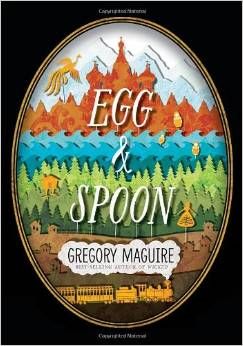
Gregory Maguire, the author of Wicked, Son of a Witch, and other novels, is
set in Russia. The twists of the plat in Egg
& Spoon (Candlewick Press, 2014) take the reader to a little village, to
the Tsar’s palace in St. Petersburg, to the vicinity of the City of Archangelsk
(called in the book Archangel), and farther to the North. It is a lengthy book.
Some
of the characters are clearly Russian. Soon after leaving a village devastated
by poverty and hunger, we meet Baba Yaga, the Firebird, the last Russian Tsar Nikolas,
and even Rasputin (although he does not have a big role in the plot). There are
also two girls, one rich and one poor, who by mistake exchange their roles and
fates. For the sake of symmetry, there are two eggs, a Faberge egg and a
Firebird egg. Alas, there is only one prince Anton, a young nephew of the Tsar.
The plot is
too complicated to retell. It starts with the meeting between Elena, an
uneducated but smart and adventurous pauper girl whose father is dead and
mother is dying, and Catherina, a French and English speaking high society girl
who travels with her great-aunt to the capital to take part in the Tsar’s ball
and to be introduced to the Tsar’s nephew.
After the
adventures at the ball, girls and Anton start a journey to the North with Baba
Yaga and her talkative, mischievous cat. The means of transportation, as you
might predict, is the little hut on the chicken’s legs. In the end, the
narration breaks into a pure fantasy without much relation to Russian folklore.
A snow dragon they meet in the North is not native to Russia but rather to Japan.
As in his other books, Maguire works out a new frame for old tales.
Surely,
Baba Yaga is the most colorful personage in the book. She came from a Russian fairytale,
but she acquired a bit of an American accent. She likes using some modern
American expressions. The narrator, an old monk locked in the prison tower,
admits that he does not always understand what she is talking about. Baba Yaga
collects items from the future and from the past, and she knows a lot about the
world.
She
presumable is able to travel through time and space. She knows, for example,
about the real-estate in the Bronx and about Gregor Mendel’s experiments on plant hybridization. She visits Bloomingdale Department
Store and keeps in her hut the furniture pieces which have minds of their own
and like to change their shape and content. Baba Yaga is a charming character
with constant mood swings. At first, she looks like an old witch who is ready
to eat a child lost in the woods, and at the end she is more like a tender
granny for young characters in the book.
The
story moves fast, and it is full of adventures. It is told with a sense of
humor and more than enough improbable details (the Russian Tsar, for example, freely
quotes Darwin). There are plenty of Matreshkas; there is no lack of typical Russian
doom and gloom. If you know Russia (most of the readers will not), you might
find it a bit inconsistent. Please be also ready to forgive some inaccuracies
in Russian geography. Still, it is a good read.
The
book also has an interesting ecological motif. The reason why the expedition to
the North was conceived is that the winter was too warm which caused distress
to Baba Yaga, floods in St. Petersburg, and a “global” (all-Russian) climate change
promising more hunger in the villages.
The Candlewick Press forefronted the book at the Book Expo
America in June and put it on the cover of the 2014 catalog. Does it promise a
rising interest in Russia themes and some chances for the Russian children’s books
to enter the US markets? You wish.


