Showing posts with label Russian children's literature. Show all posts

Tuesday, July 16, 2013

Call for Papers: CHILDREN'S LITERATURE AS A TERRITORY OF CONFLICTS: TEXTS, PERSONALITIES, AND INSTITUTIONS


CONFERENCE ANNOUNCEMENT AND CALL FOR PROPOSALS

RESEARCH CENTER FOR RUSSIAN CHILDREN'S LITERATURE
INSTITUTE OF RUSSIAN LITERATURE (THE PUSHKIN HOUSE)
ILLINOIS WESLEYAN UNIVERSITY
URAL FEDERAL UNIVERSITY

 CHILDREN'S LITERATURE AS A TERRITORY OF CONFLICTS: TEXTS, PERSONALITIES, AND INSTITUTIONS

June 1-4, 2014

Institute of Russian Literature (The Pushkin House)
St. Petersburg, Russia

This international conference will discuss children's literature as a territory of conflicts: institutional, personal, and textual. Presentations might address issues such as:
Antagonisms between the state and the writer/reader, problems of religious and political censorship, tension between traditional and innovative forms of children’s literature, previously silenced and taboo subjects (gender, disability, race, ethnicity, sexuality, criminality, death, etc.), generational differences and conflicts, shifts in aesthetic norms and values, construction of the canon and mechanisms of canonization of children’s literature, multiple adaptations and translations of foreign texts, historical conceptions of plurality within children’s literature, children’s literature in the school curriculum, etc. 

Proposals may also address:
·       Innovative authors of children’s books and their careers
·       Professional, regional, and informal societies of writers
·       History of different generations of children’s writers
·       Problems and conflicts in national children’s literatures
·       Theoretical and critical approaches to children’s literature

Please send us your 300-word proposal and a short bio by September 1, 2013. You will be notified by October 1, 2013, if your abstract has been selected for the conference.

Working languages: Russian and English

Contact informationdetlit2014@gmail.com

Organizational committee:
Marina Balina, Illinois Wesleyan U
Valentin Golovin, Institute of Russian Literature (The Pushkin House)
Mariia Litovskaia, Ural Federal U
Svetlana Maslinskaia, Institute of Russian Literature (The Pushkin House)
Larissa Rudova, Pomona College
Inna Sergienko, Institute of Russian Literature (The Pushkin House)
Valerii Viugin, Institute of Russian Literature, St. Petersburg

Sunday, December 4, 2011

Minutes from the WGRCLC Meeting at the ASEEES Annual Conference in Washington D.C.


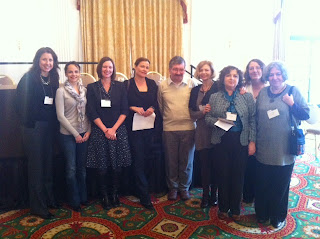
The Working Group for the Study of Russian Children's Literature and Culture met on November 20, 2011 on the last day of this year's ASEEES conference.  Here are the minutes for those of you who were unable to attend:


1. I (Kelly Herold) accepted the position of the website editor-in-chief. If you have any suggestions or corrections for the site, send them my way at kellyherold@gmail.com or heroldk@grinnell.edu.


2. Ol'ga Bukhina volunteered to assist in managing the web site.  (Thank you, Ol'ga!)

 3. Ol'ga Bukhina will become a co-author on this blog.  She will write a post or two weekly on children's and Young Adult books in Russia.  Again, I remind you that multiple authors are welcome.  Blog authors may write in English or Russian or in a (comprehensible) mix of the two. Write or leave a comment if you'd like to participate!


4.  Sara Pankenier Weld will establish a Facebook group for WGRCLC.  Look out for an invite or an add to the Facebook group.  


5. Jacqueline Olich will make our presence known on Twitter. As soon as a feed is active, we'll let you all know!


6. Ol'ga Bukhina has agreed to serve as the Book and film review editor for the WGRCLC site for the rest of academic year 2011-2012.


7. Marina Balina will continue to manage the Bibliography on the WGRCLC website.

8. Larissa Rudova will keep us posted on research and news on the WGRCLC site.

Other Matters of Business:


1. Let's establish closer ties with ChLA. Perhaps we should propose a panel for the ChLA Annual Conference?


Important information: ChLA 2012 will meet in Boston at Simmons College, June 14-17. The theme of the conference is "Literary Slipstreams." Abstracts are due January 15 and should be submitted electronically to childrensliterature@simmons.edu


Questions raised at the meeting included: Should we propose a panel? Should we contact the association and propose a possible affiliation?


2. Let's think about possible participation at the International Conference "The Fairy Tale Vanguard."


Important information: It will take place at Saint Peter's Abbey in Chent, Belgium, from August 20-August 22. 


An abstract of 300 words is due before March 1. It should be sent to www.fairytale@ugent.be
 

3. Members of the group suggested that the acronym WGRCLC is unwieldy.  Does anyone have a suggestion for a new name?  Ideas are welcome! 

4. We also began a fascinating discussion on the relationship between textbooks and children's literature.  Summaries of this discussion would be welcome.

Monday, September 26, 2011

Grigorii Oster's "Deti i eti"

Good news! Grigorii Oster is hard at work on a new series, Deti i eti.  Of the series, Oster says, "cерия этих книг представляет собой новый жанр - смешные короткие истории, которые также являются психологическими практиками."  The second volume of the series,  Дети и Эти 2. Попугаи с вареньем, has just been released.

The publication of Deti i eti reminds me that I wanted to pose a question here to those of you reading this blog.  Why, do you think, does the very short story for children remain such a popular option in Russia?  It's a form that has long fallen out of favor in Anglo-American publishing (and was never popular in the United States) except for in magazines for children.  Don't get me wrong: the continuing popularity of the very short story in Russia is a strength of Russian children's literature.  It works well for children learning to read and for adults reading with children.  I have my own theories, especially as to why the genre has disappeared in the U.S., but I wonder what you think.

News from RIANovosti, link via the Facebook group Культура детства: нормы, ценности, практики


Thursday, June 23, 2011

News Roundup and Apologies

Please excuse my long absence from this blog.  I have been traveling and have had limited access to the internet.  I am back online, however, and will resume posting 3-4 times a week.  Feel free to send links or news my way!

--------------------

Here are some recent stories and reviews about and of Russian Chidren's and Young Adult literature in the Russian press:

Rozovoi zhiraf's General Director Julia Zagachin is interviewed once more, this time at newsland.ru.  When asked about books for teens, Zagachin says:
Действительно, по нашему мнению литературы для подростков, которая отвечала бы именно на те вопросы, которые волнуют их здесь и сейчас, говорила бы с ними на понятном языке, не занималась бы нравоучениями, а показывала бы различные жизненные ситуации и различные пути выхода из них, остро не хватает.

And speaking of Rozovoi zhiraf and their publishing ventures for teens, Rita Rusakova reviews the recently-issued Russian translation of Lois Lowry's classic The Giver (Дающий) for Kommersant.  It's an excellent review in the sense that Rusakova focuses on the significance of The Giver in American Young Adult literature as well as on Lowry's brilliant unfolding of The Giver's dystopian world in the text.  Rusakova explains,
Особенно страшно потому, что этот чудесный мир, состоящий из совершенно одинаковых коммун, показан в книге глазами ребенка, другого мира не знающего, а тот, который есть, считающего единственно возможным и правильным.
Elena Elagina interviews Natalia Svirina (профессор, завкафедрой педагогики Института специальной педагогики и психологии, научный руководитель Ассоциации гимназий Санкт-Петербурга) about the importance of reading aloud to children in Literaturnaya gazeta.

Galina Iuzefovich writes about selecting good summer reading for children in the June 6 ItogiIuzefovich has lots of advice, but most of it is based on the following opinion:
А смотреть нужно туда, куда взгляд неопытного покупателя падает в последнюю очередь, — на неприметные стеллажи, максимально удаленные от так называемой привилегированной выкладки. Там, как правило, располагаются книжки, выпущенные маленькими издательствами — теми, где в самом деле любят детскую книгу и готовы вкладывать время, силы и деньги в ее создание.
Happy reading!

Sunday, May 29, 2011

Database of Russian readers and alphabet books (1900-1917)

The K.D. Ushinskii Nauchnaia Pedagogicheskaia Biblioteka has posted a bibliography of Russian educational readers and alphabet books published during the years 1900-1917.  Full bibliographic information is available for each book listed and some are available to read in pdf format.  The authors of the bibliography explain the project as follows:


Важным инструментом исследования эволюции педагогических идеалов в учебной литературе для начальной школы 1900-1940 гг., детального исследования механизмов, позволяющих обучающимся впитывать абсолюты воспитания и обучения, является, на взгляд исследователей, всесторонний анализ процесса создания школьных учебников, их распространения, изучения в классе и дома. Именно через свой первый учебник помимо игр, развлечений и познавательных экскурсий ребенок знакомится с внешним по отношению к семье миром. Визуальным рядом и собранием текстов учебная книга создает для ребенка своего рода «словарь мира», претендующий на роль когнитивной матрицы.
Many thanks to the K.D. Ushkinskii Nauchnaia Pedagogicheskaia Biblioteka for an invaluable resource.

Monday, March 7, 2011

Interview with Elena Tsesarevna Chukovskaya

Tat'iana Shabaeva of Rossiiskaia gazeta interviews Elena Tsesarevna Chukovskaya, winner of the 2011 Aleksandr Solzhenitsyn prize, for Jewish.ru.  In the interview Chukovskaya discusses working with Solzhenitsyn and her important work with her grandfather Kornei Chukovsky's archive. It's a fascinating interview you should read in its entirety, but I found this question and its answer particularly interesting:

Т.Ш.  Корней Иванович кем видел себя в первую очередь? Детским писателем? Литературным критиком?

Е.Ч.  Корней Иванович по рейтингу детских авторов занимает сейчас первое место с большим отрывом. Его действительно издают очень много. Но именно детские книги. И отношение его к этому было сложным. Он говорил, что на его памятнике напишут: Автор "Мойдодыра". Ему это было смешно. Сам он считал себя критиком, литературоведом, вполне сложился ещё до революции, уже тогда был известный критик. Но, на самом деле, детские книги были большой частью его жизни. С тех пор, как он в 1911 году в книге "Матерям о детских журналах" обратился к родителям с просьбой присылать письма о том, что их заинтересует в их ребенке, он получал огромное количество писем и отвечал на них. Книга "От 2 до 5" - это книга по детской психологии, в ней сформулированы "Заповеди для детских поэтов". Он шел к детям с двух сторон: со стороны поэтической культуры, которой он владел, и со стороны детской психологии. Поэтому его сказки и  живут так долго.


А разносторонность его литературных занятий вполне проявлена в недавно завершенном "Собрании сочинений" в 15 томах.

You can find information on the Aleksandr Solzhenitsyn prize here.

Wednesday, February 23, 2011

The Kniguru Prize

On November 11, 2010, the Bol'shaia kniga committee announced a new award, Kniguru.  This prize will be for the best Russian work of 2010 for children and Young Adults.  The organizers note that the name of the prize was chosen by children. (It's pretty good, isn't it?)

A panel of children's book experts will select first a long list of nominated books and then a short list of the best for a jury of youngsters ages 10-16 (those registered on the official site) to consider.  This "jury" will ultimately choose the winning book whose author will receive an award of 300, 000 rubles.


A press release from February 4 announces that the contest has now closed and there will be 403 books considered. The Fairy Tale and Fantasy are most popular in this first year, with the Young Adult realistic novel in third place.

Monday, February 21, 2011

Interview with Liudmila Ulitskaya

Don't miss Galina Iuzefovich's interview with Liudmila Ulitskaya for Itogi, published today.  In the interview, Iuzefovich asks Ulitskaya about her children's book series project--Другой, другие, о других.  Iuzefovich asks, "Если уж говорить о людях не вполне взрослых, то хотелось бы спросить о вашем книжном проекте — цикле познавательных книг для подростков. Почему вы, писатель, а не редактор, не издатель, вообще за него взялись?"

Ulitskaya's answer is very interesting.  She says:
  • Я бы предпочла, чтобы проектом «Другой, другие, о других» занимался кто-нибудь другой. Другого не нашлось, а у меня было такое ощущение, что проект этот необходим. Если бы наше государство вкладывало деньги в воспитание уважения к другому человеку, к другой культуре, то это могло бы сбросить то напряжение, которое мы сегодня наблюдаем. Те бывшие мальчики, которые вышли на Манежную площадь в декабре, может, не были бы так агрессивны, если б их больше любили, прижимали к груди и объяснили с малолетства, что мир велик, история длинна, культура разнообразна, другой человек имеет право на жизнь, даже если у него другого цвета кожа, он ест другую еду, носит другую одежду и у него иные обычаи. Интересно же." 
If you're interested in Ulitskaya's book project, you can read the first four books in the series in English at the UNESCO site.

Sunday, February 20, 2011

Welcome

Welcome to the Working Group for Study of Russian Children's Literature and Culture blog. My name is Kelly Herold (Grinnell College, Russian Department) and I am the blog administrator.

On this blog you will find news about Russian children's literature and culture, links to reviews, and announcements from the Working Group for Study of Russian Children's Literature and Culture (WGRCLC).  We will be posting a few times per week, so check back often or put us in your blog reader.

If you are interested in blogging on Russian Children's Literature and Culture on a regular basis, we welcome your participation.  Posts may be written in Russian or in English.  If you are interested in participating, please send me an e-mail.